
She got the promotion, and you said nice
When she shares good news and you answer 'achha, nice' without looking up, it does not land. Put the phone down and ask two questions about the news itself.
- autopilot
- hermes
- connection
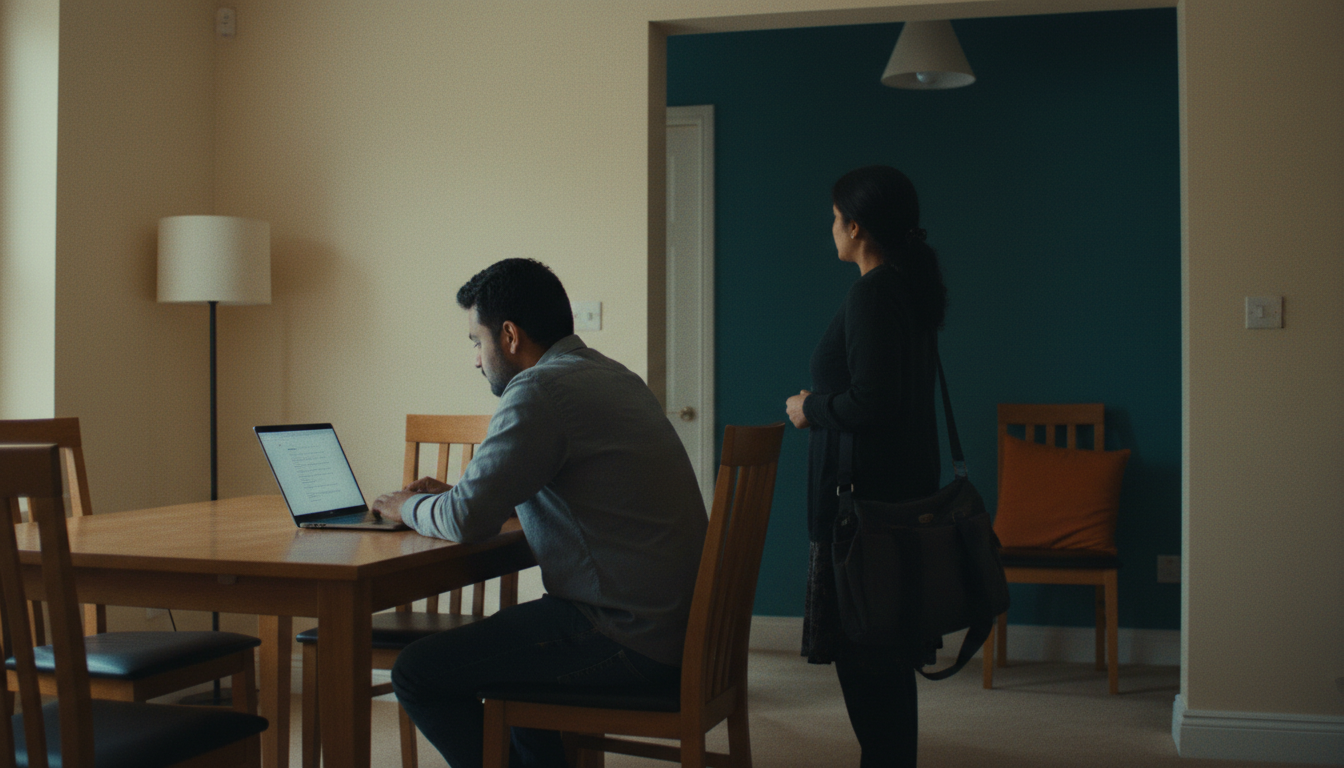
It is eight at night. You are at the dining table finishing one last office mail. She walks in, bag still on her shoulder, and says, "Mera promotion ho gaya."
You say, "Achha, nice." Your eyes stay on the laptop. She stands there for a second, says "haan," and goes to change.
Later you hear her on the phone in the bedroom, laughing, telling her sister the whole story. The room, the manager, the exact words. All of it, the part you never asked for.
Nothing about that evening looks like a fight. But something small was handed to you and it did not land.
Four ways to answer good news
Psychologists who study how couples share good events sort the answers into four kinds. You can hold them against your own week.
- Asks and stays with it. "Poora batao. Kisne bataya? Tumne kya kaha?" The listener asks questions and is plainly interested.
- Pleasant but brief. "Achha, nice." Kind in tone, and over in a second.
- Finds the problem. "Promotion means longer hours, no?" The news becomes a worry.
- Does not notice. The laptop stays open, or the talk turns to something else.
Only the first one gives the news somewhere to go. The second looks harmless, which is why it is so easy to miss in your own voice.
What the research found, and what it cannot say
Shelly Gable, Harry Reis, Emily Impett and Evan Asher published studies in 2004 on how couples respond when one of them shares something good. They used surveys and diary records from couples. Partners who answered good news by asking questions and staying with it were reported as having higher satisfaction, intimacy and trust in the relationship. The flat, brief answer sat on the other side of that line.
This is an association. It cannot say that the questions caused the closeness: couples who already feel close may simply ask more. It does give you a reason to treat "achha, nice" as worth noticing, because it is the answer that costs the least and gives the least.
What a good answer sounds like
It does not need to be clever. It needs to be curious about her side of it. Ask about the room when she was told, the face of the person who said it, the first thing she felt. Those are the parts she was holding while she walked in with her bag still on her shoulder.
Notice that none of these questions is about you. You do not need to say how proud you are, or what you two will do with the money. Those can come later. First she needs to be heard telling it once, to the person she came home to.
Why you answered that way
You were not being cold. You were halfway through a mail, your mind was on the send button, and "nice" is what comes out when your attention is elsewhere. It is a reflex, not a verdict on her news.
But she cannot see the mail. She sees a man who heard her say something big and did not look up. So she takes the story to her sister, who looks at her while she tells it.
One thing to try tonight
The next time she tells you something good, do two things, in this order.
First, turn your phone face down, or close the laptop lid. Do it where she can see it. It takes two seconds and it says what a sentence would take longer to say.
Second, ask two questions about the news itself, not about what it means for you. For example: "Poora batao. Kisne bataya?" Then: "Tumne kya kaha?" Then listen to the answer without fixing anything or adding a worry.
The first try may feel a little stagey. After the second question your mind may say, "Now what do I ask?" Ask one more. The story probably has more in it than you knew, and a third question about the same moment is a fair place to go.
It may also not go smoothly. She may be surprised, or wary, if this is new. Try it for a week with whatever good thing comes up, small ones included, before you decide what it means.
A note on what this is
This is relationship education, not therapy or medical advice. If any part of this describes what is happening in your relationship, a qualified professional or a local support service is the right next step, and not an article.
Where to go next
Each Sunday: one question to ask your partner, the research behind it, and one thing to try. The free Relationship Checkup is open to everyone, any time: take the Relationship Checkup.
One question a week.
Each Sunday: one question to ask your partner, the research behind it, and one thing to try. The free Relationship Checkup is open to everyone, any time.