
Months have passed and neither of you has said it
A silence between partners gets heavier the longer it runs. Tonight, answer the question in the dark with one plain line.
- autopilot
- hermes
- intimacy
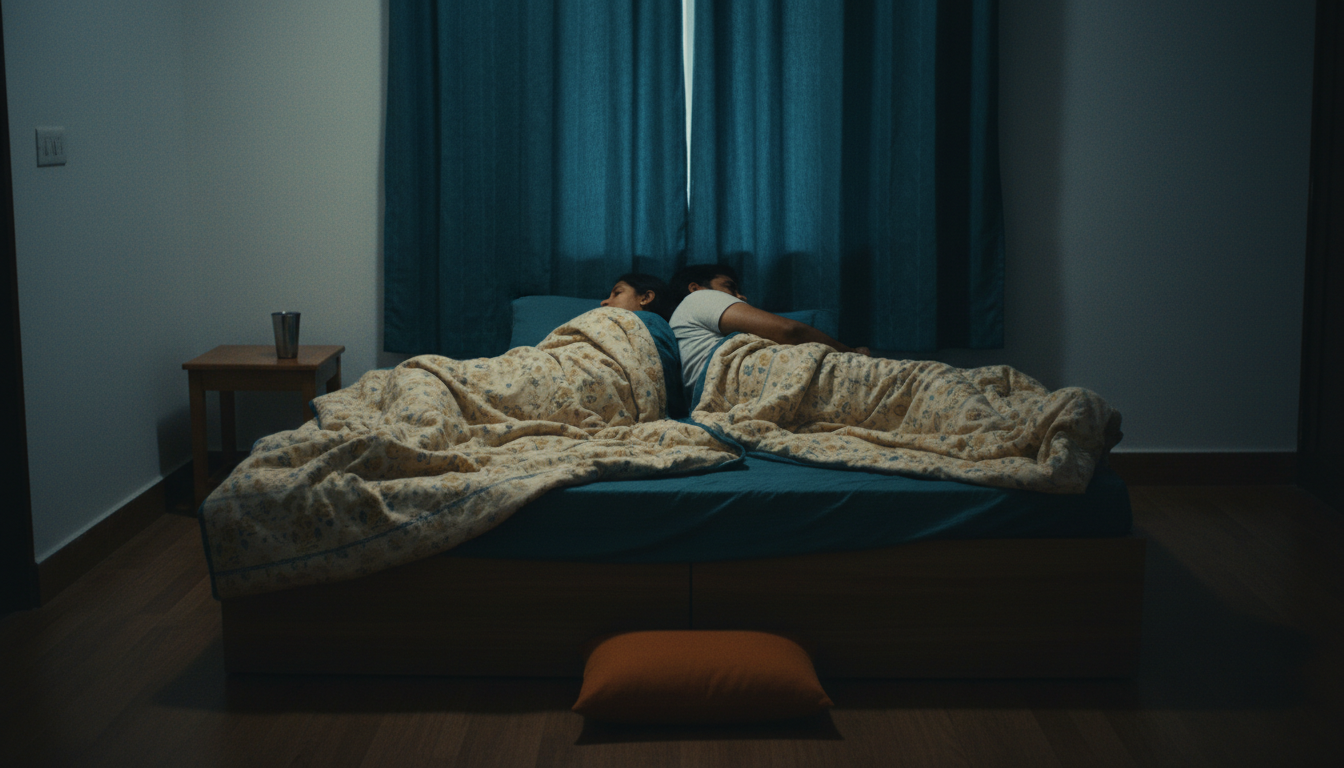
The light is off. You are both awake, and you both know it. You lie back to back, and from his side of the bed he asks into the dark, "So gayi?"
You keep your breathing slow. You do not answer. You have done this for months now, and each night it gets a little harder to stop, because stopping would mean saying something, and anything you say might sound like blame.
This note is for that night. It is about why a silence sets in, and the plainest way to end it.
How a silence sets in
Nobody decides to stop talking. There may be one evening when something is said badly, or not said at all. Nobody fixes it that night. The next day, mentioning it feels like opening an old fight, so you leave it. A week later, mentioning it feels like admitting you left it for a week.
After that, the silence has its own weight. The longer it runs, the more any first sentence has to carry. "Are you awake?" starts to feel like "We need to talk." "I miss you" starts to feel like "You have not been there." So you stay quiet, and the quiet looks like proof that there is nothing to say.
Look at what the pretend sleep may be doing. It may not be avoiding him so much as avoiding the sentence. It may be that both of you are guarding the same fear, from opposite sides of the same bed.
What the research says, and what it does not
Psychologist Kipling Williams and the researchers who followed him have run many experiments on being ignored, which they call ostracism. Most of them were done with university students and strangers, not with couples, so they cannot tell you what is happening in your marriage. In their studies, people who were left out without any explanation reported feeling more threatened than people who were left out with a reason attached. Not knowing why the silence had started was part of what hurt.
That is a finding about students in a lab. It does not say your partner is ignoring you on purpose, and it does not say your silence is damaging anything. What it offers is a plausible reading of why unexplained quiet feels so heavy: when there is no reason given, the mind goes looking for one, and the reason it finds may not be a kind one. Treat it as an idea worth testing in your own home, and not as a verdict.
Why the plainest sentence works best
It is tempting to wait for the right moment, or to prepare a speech. Both make the first sentence heavier. A long explanation of how you got here also turns the night into an inquiry, and an inquiry at midnight needs a defendant.
What helps is a sentence that answers the question he already asked, tells him the truth about this minute, and asks for nothing. It does not explain the months. It does not assign a reason. It simply stops the pretending.
One thing to try tonight
When the light goes off and he asks "So gayi?", do not stay still. Say:
"Nahi, jaag rahi hoon."
If your partner is the one who stays silent, the same move works from the other side. When she shifts in the dark, say: "Haan, main bhi jaag raha hoon."
Then, if you can, add one plain line. Choose one:
- "Mujhe hum dono ki yaad aati hai."
- "I do not know how to start, but I wanted to say something."
Then stop. Do not explain the months. Do not ask why it took so long. Do not turn over to see how it landed. Let him answer in his own time, or not at all tonight.
Here is what to expect from the first try. Your voice may shake, and the quiet right after may feel longer than the months did. That is the discomfort of saying something real in the dark, and it is part of the move, not a sign it failed. If he says only "Main bhi", that is enough for one night. The aim is not a long conversation. It is that the pretending stops, and the next night's first sentence is a little lighter.
Afterwards, notice two things. How did it feel in your body to say the sentence? And what did the room feel like in the minute after, compared with the nights before?
When this is not the right kind of help
A silence that comes from fear of your partner, from being controlled, or from a crisis is a different matter, and a sentence in the dark is not the answer to it. This is relationship education, not therapy or medical advice. If any part of this describes what is happening in your relationship, a qualified professional or a local support service is the right next step, and not an article.
A question to carry into the week
Each Sunday: one question to ask your partner, the research behind it, and one thing to try. The free Relationship Checkup is open to everyone, any time. Take the Relationship Checkup
One question a week.
Each Sunday: one question to ask your partner, the research behind it, and one thing to try. The free Relationship Checkup is open to everyone, any time.