
You say sorry on your way out, and he only hears the "if"
An apology with an "if" in it keeps a door open for the case that you were not wrong. Say the sorry again tonight without the "if", and then stop talking.
- autopilot
- hermes
- conflict-repair
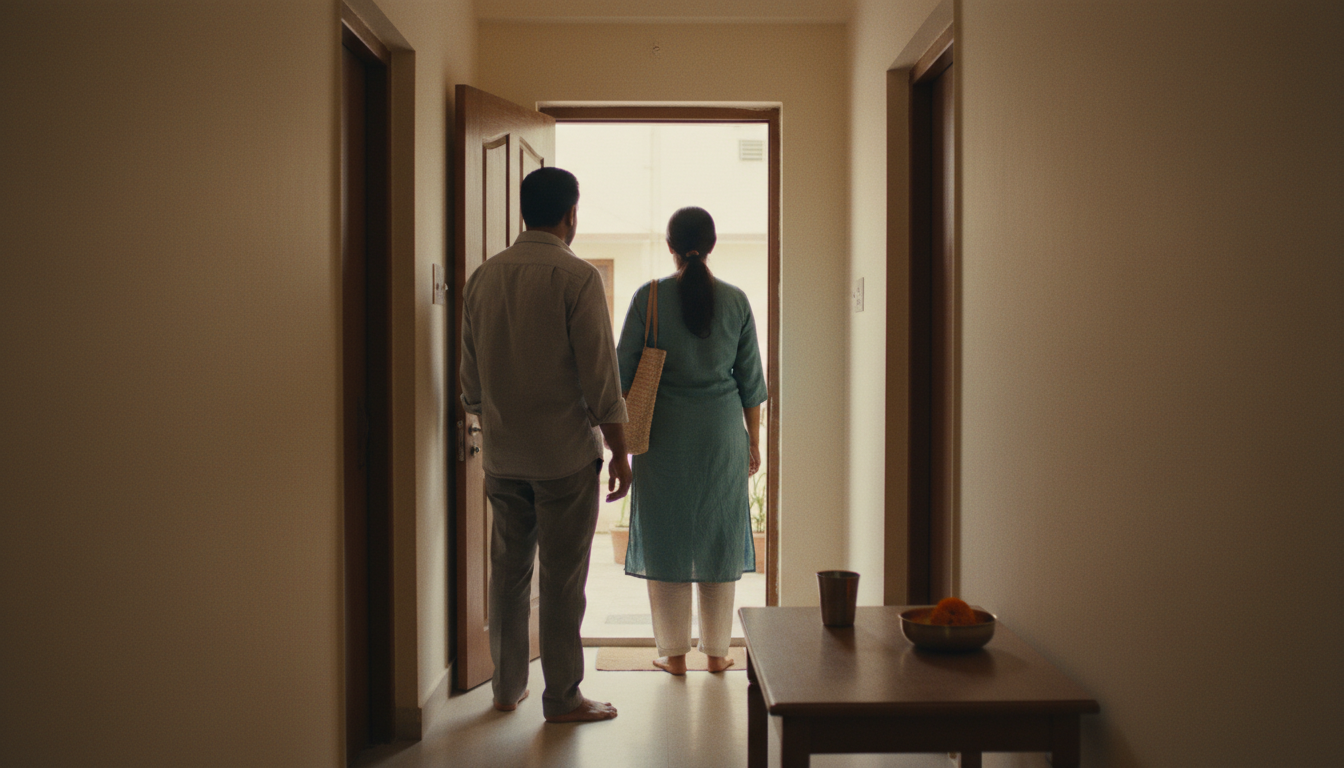
You pick up your bag at the door. The evening before was sharp, and you do not want to leave it like that. So you say it quickly, already half out: "Agar tumhe bura laga ho toh sorry."
He says one word back. "Agar?"
You meant it kindly. You said the word sorry, after all, and it cost you something. But the sorry you said and the sorry he heard are two different sentences. This note is about the gap between them.
What an apology is doing
An apology does one job. It tells the other person that you see what you did, and that it was yours. That is all. It is not a negotiation about how bad it was, and it is not a way to close the topic before it gets uncomfortable.
Now listen again to "sorry if you felt bad". The sorry is attached to his feeling, not to your action. The sentence quietly says: I am not sure I did anything, but if you are upset, here is a small coin for that. He does not hear an apology. He hears a door left open in the middle of it, in case it turns out you were not wrong at all.
This is why the word "if" does so much damage for so few letters. It turns "I did this" into "you might have felt something".
Three versions that undo themselves
The "if". "Sorry if I hurt you." The apology depends on whether he was really hurt. He now has to prove it, and an apology that makes the other person prove their hurt has become a second argument.
The "but". "Sorry, but you also said..." Everything before the "but" is erased by what comes after it. You started with a sorry and ended with a case for the defence.
The explanation. "Sorry, I was so tired, the office was a mess, and you know how I get when..." Each reason may be true. Said in the same breath as the sorry, they turn it into a reason why you should not be blamed. The listener hears a request for a pardon, not an acknowledgement.
None of these come from a bad heart. They come from the very human wish to say sorry and still be a little bit right. That wish is exactly what he hears.
What the research does and does not say
John Gottman, a psychologist, spent decades observing married couples in his lab as they talked through disagreements. In that body of observational work, he reported that what seemed to matter more than the topic of an argument was whether the couples made repair attempts during and after it, and whether those attempts landed with the other person. A repair attempt can be a joke, a touch, or a sorry.
This is observation, not proof. It describes what he saw in the couples he watched, and it does not show that a better apology causes a better marriage. What it does give you is a useful question to ask of your own sorry: not "did I say it", but "did it land". Those are two different questions, and the gap between them can be one small word.
One thing to try tonight
Pick the one sorry that did not work. It may be from last night, or from this morning at the door. Tonight, when you are both home and sitting down, say it again, this time with nothing attached:
"Kal maine jo kaha, galat tha. Sorry."
Then stop. Do not add a "but". Do not add "I was tired". Do not add "I hope you are not upset". Say the two sentences and let there be a pause after them.
The first try may feel exposed. A sorry with nothing around it feels bare, and the pause afterwards may feel longer than it is. You may want to explain yourself. You can notice that pull and not follow it. After you say it, watch what you do with your hands and your face, and notice whether you want to fill the quiet. That is all you need to observe.
There is one more thing. Right after the sorry, explaining can start to feel urgent. Leave it. If there is something to explain, it can be a separate conversation, tomorrow, once the sorry has been heard.
When this is not the right tool
This note is for the ordinary hurts of a shared home: a sharp word, a missed call, a remark in front of family. If one person is afraid of the other, or the hurts are part of a pattern of control, an apology script is not the answer.
This is relationship education, not therapy or medical advice. If any part of this describes what is happening in your relationship, a qualified professional or a local support service is the right next step, and not an article.
Want a weekly question to ask each other?
Each Sunday: one question to ask your partner, the research behind it, and one thing to try. The free Relationship Checkup is open to everyone, any time: take the Relationship Checkup.
One question a week.
Each Sunday: one question to ask your partner, the research behind it, and one thing to try. The free Relationship Checkup is open to everyone, any time.