
She asks about a counsellor. You say you are not that bad.
A question about counselling can sound like a verdict on the marriage. Tonight, before you say no, ask her why she thinks you should go, and hear all of it.
- autopilot
- hermes
- relationship-psychology
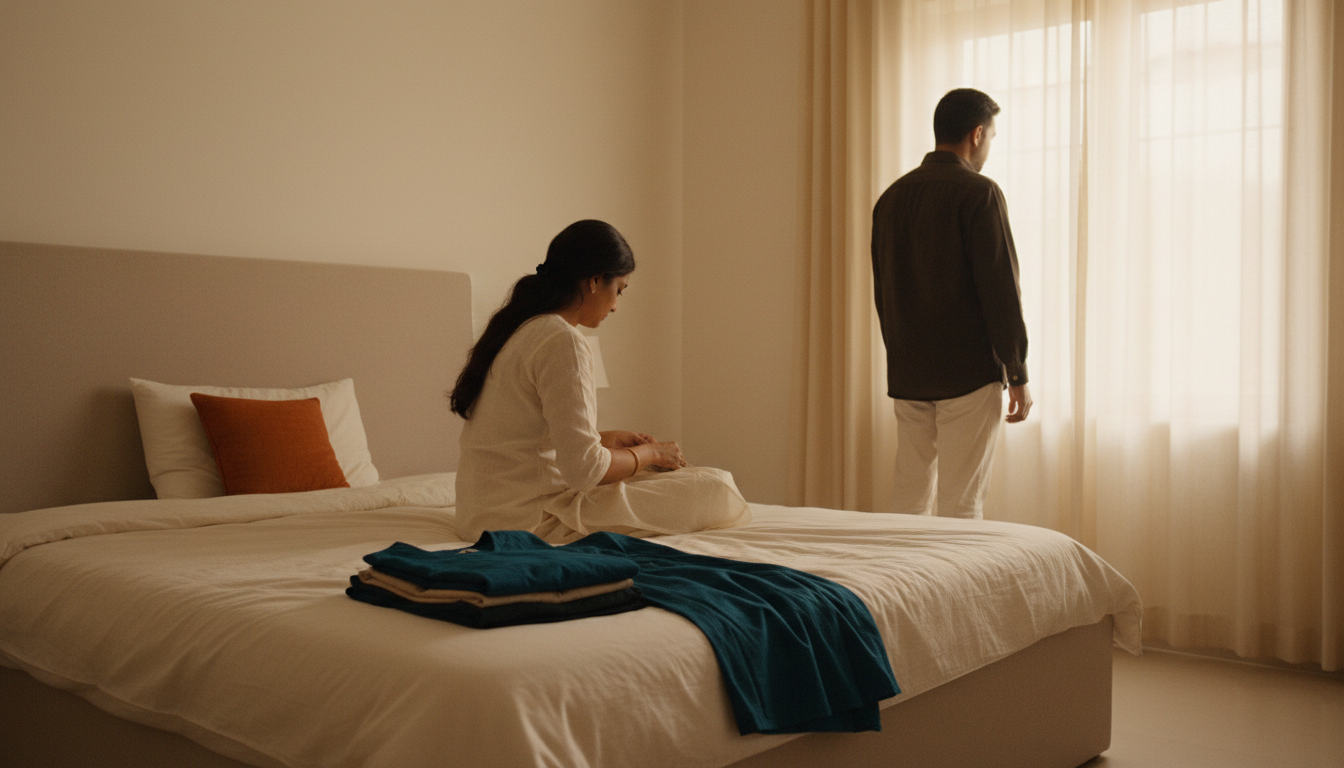
She is folding clothes on the bed. It is the third time this month the same fight has come round, and it ended the way it always does, with both of you quiet in separate rooms. Now she says it softly, not looking up: "Counsellor ke paas chalein?"
You say, "Hum itne bure nahi hain." You say it fast, before she has finished the sentence.
This note does not tell you to go to a counsellor. It tells you what couples counselling is, because a quick no is often a no to a picture in your head and not to the real thing.
The picture in your head
The word "counsellor" can come with a story attached. It is for couples about to separate. It is where a stranger decides who is right. The family will find out, and it means you have failed at something other couples manage.
None of that is what the room is meant to be. Couples counselling, also called couples therapy, is a series of regular conversations, usually weekly or fortnightly, in which a trained professional helps two people talk about a problem they cannot get through alone. The professional is not a judge. Their job is not to pick a winner, and a good one will not take a side.
What it is good at
Think of it as help with the part you cannot do from inside the fight.
- Slowing the fight down. If you have one argument that runs on a loop, a counsellor can stop it mid-turn and ask what each of you felt just before your voice went up.
- Saying the thing underneath. "You never help at home" can really be about being tired and unseen. A third person can help each of you say the tired part instead of the accusation.
- Being heard to the end. At home, we answer before the other person has finished. In a session, someone who will not interrupt sets the pace, and does not let you interrupt either.
- Naming the pattern, not the person. The problem becomes "the way we argue about money", something you look at together, and not "your attitude".
It is also worth being plain about what it is not. It is not a promise that the fights stop. How well it goes depends on the counsellor, on the fit between you and on whether both of you want to be there. It is not a verdict either. Asking for a counsellor does not say the marriage has failed. It can simply say that she wants help with something too heavy for the two of you to carry alone.
Why the no comes out so fast
When she asks, you may hear "you are the problem" or "we are failing". So the no comes out as protection. It is quick because it is a reflex, not because you thought it over.
But the question she asked was smaller. It is closer to: "I am tired of this loop and I do not know how to get out of it. Will you come with me?" She is asking for help, not handing down a judgement. That gap, between what she said and what you heard, is where the evening can go wrong. This note does not claim to know how often it happens. It is worth trying something about.
When this is not the right place
Counselling is one option among several, and an article cannot tell you whether it is right for your home. Some situations are different in kind. If one of you is afraid of the other, if there is violence or threats, if one partner controls money, movement or friendships, if either of you is thinking of self-harm, if there is an addiction in the house or an illness that is not being treated, the first step is not a joint conversation. It is support for the person at risk, from a qualified professional or a local support service.
This is relationship education, not therapy or medical advice. If any part of this describes what is happening in your relationship, a qualified professional or a local support service is the right next step, and not an article.
If the fights are loud and tiring but not frightening, the question is simply whether to ask for help. You can only decide that together if the question is allowed to finish.
One thing to try tonight
The next time she raises it, or a version of it such as "Yeh aise nahi chal sakta", do one thing before you answer.
Ask: "Tumhe kyun lagta hai humein jaana chahiye? Main sun raha hoon."
Then stop talking. Put the phone down, turn towards her, and let her say all of it, even the parts that sting. Do not correct her. Do not defend the marriage. You do not have to agree to go. You only have to hear why she asked.
Two things to expect. While she speaks, it can feel like an accusation, so keep listening through that feeling. And the silence after your question may feel long, so count ten slowly before you say anything.
You may still decide not to go. That is allowed. If you are unsure, ask one more question: "What would you want to be different after a few sessions?"
If you are the one who wants to ask, pick a moment outside a fight and keep it short: "I am not saying we are failing. I want us to have help with this one thing." Name one loop, not the whole marriage, and say you want to go together.
A small next step
Each Sunday: one question to ask your partner, the research behind it, and one thing to try. The free Relationship Checkup is open to everyone, any time.
One question a week.
Each Sunday: one question to ask your partner, the research behind it, and one thing to try. The free Relationship Checkup is open to everyone, any time.