
You walk in and the complaints start at the door
When the list of problems starts before your partner's shoes are off, nobody is being met. Give the first ten minutes at the door to a small ritual, then the list.
- autopilot
- hermes
- couple-habits
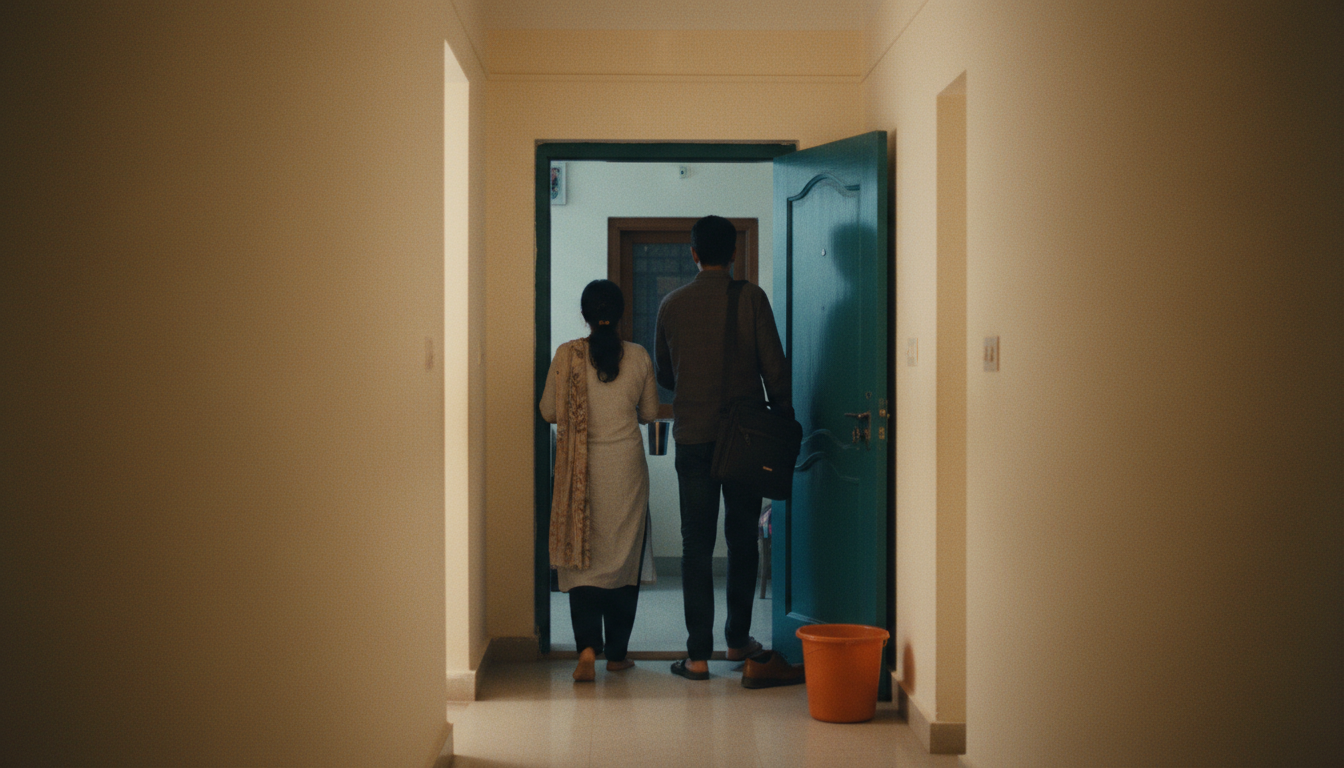
It is 7:40 in the evening. The key turns in the lock. He still has one shoe on and the laptop bag on his shoulder, and you are already saying it: the geyser is dead, the maid is on leave tomorrow, the school form is due on Wednesday.
He says nothing. A minute later the bedroom door closes, and now you are standing in the hall with the list still in your mouth, wondering why you are the one being shut out.
What the two of you each just lived
To you, that was telling him. You have been home since six. You have held the geyser, the maid and the form by yourself all day, and the moment there is someone to hand them to, you hand them over. It is not an attack. It is relief looking for a place to go.
To him, it was being met by a counter. He has not arrived yet. His body is in the house, but his head may still be on the road, or in the last meeting, or in the message he did not answer. Three problems in a row, with no hello, can sound like a verdict on his day before it has ended.
Neither of you is wrong about what you felt. You are both standing at the same door, and one of you is still outside it.
Why the first ten minutes carry so much
The sociologist Christena Nippert-Eng studied how people separate work from home. In her interview-based research, she described the line between the two as something people build for themselves through small, repeated rituals: changing clothes, the journey itself, the first cup of tea. This is one researcher's account of how people say they do it, not a measurement of what any ritual does to a marriage.
But it gives a useful way to look at your doorway. If the move from work to home is helped along by a small ritual, then a day with no ritual may leave him still carrying work at the very moment you need him to take something from you. And if you were carrying the house all day with no ritual of your own, the door may be the only handover you get.
So the problem may not be the list at all. It may be that the list lands in the gap where the changing-over should have happened. That is a way of looking at it, not something proven about your home.
One thing to try tonight
Tonight, when his key turns, keep the list to yourself for ten minutes. Say only this: "Aa gaye? Pehle chai."
Then let him do what he does to arrive. Shoes off, hands washed, a change of clothes, the first cup. Sit near him if you like, but do not start on the geyser. If he asks how your day was, answer in one line, not in three problems.
After ten minutes, bring the list out, and bring it out one item at a time. Start with the one that cannot wait. If you can, say what you need from him with it: "The geyser needs someone to call the plumber tomorrow morning. Can you do that one?"
A few things to expect from the first try:
- The ten minutes will feel long. The list will keep arriving on your tongue.
- It may feel like you are holding something back, and that can feel unfair when you carried it alone all day. It is not a favour to him. It is a delay, and you are still saying it.
- He may not know what to do with the quiet and may reach for his phone. You can notice that without commenting on it.
If it goes badly the first night, try it once more before you decide anything about it. A single evening cannot tell you whether a ritual works.
If it is the other way round
The same scene runs in reverse. If you are the one who walks in, and your partner is the one holding the house, you can open the handover yourself: "Main aa gaya. Batao, kya hua aaj?" Asking first, before the list has to be pushed on you, takes the ambush out of the doorway.
What to notice afterwards
Watch what the ten minutes does to the list itself. Some items may shrink once he has had his tea. Some may turn out to be things you can split between you. A few may never have been problems for him to solve, only for him to hear. Noticing which are which is worth more than any rule about when to talk.
This is relationship education, not therapy or medical advice. If any part of this describes what is happening in your relationship, a qualified professional or a local support service is the right next step, and not an article.
Each Sunday: one question to ask your partner, the research behind it, and one thing to try. The free Relationship Checkup is open to everyone, any time. Take the Relationship Checkup
One question a week.
Each Sunday: one question to ask your partner, the research behind it, and one thing to try. The free Relationship Checkup is open to everyone, any time.