
At Holi you nearly said it, and now it is Diwali
A sentence held back for the right moment gets heavier, not lighter. Tonight, open with one line that asks him for ten minutes.
- autopilot
- hermes
- communication
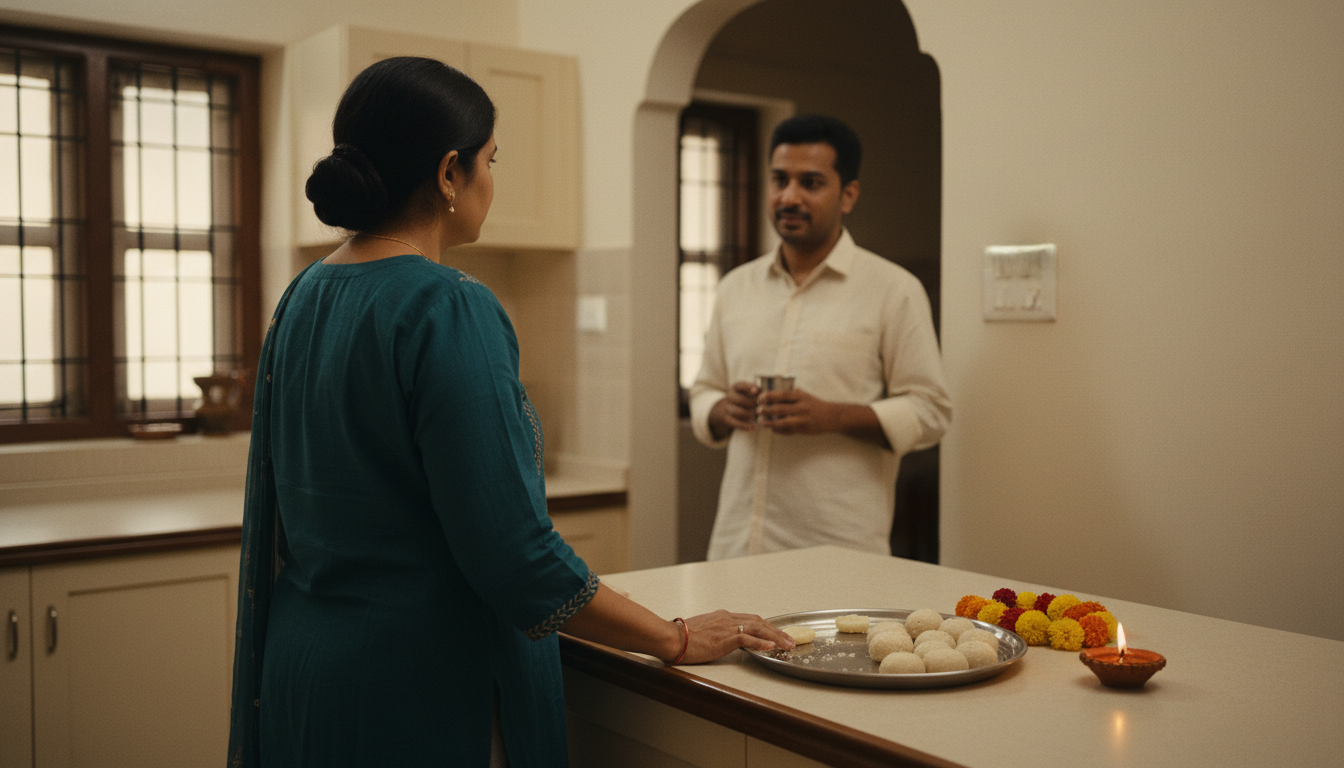
At Holi you had the sentence ready. He looked up from the plate of gujiya and asked, "Kuch hua hai?" You said, "Nahi, kuch nahi," and told yourself a better moment was coming.
Now the house is being cleaned for Diwali, and the sentence is still with you. It is heavier than it was. It no longer feels like one small thing you wanted to say. It feels like a thing you have been carrying for seven months and not saying.
Why the right moment keeps moving
Every moment you skip looks like a good decision at the time. He was tired. The guests had just left. The kids were up late. Each reason is true, and each one is also a small vote for waiting.
Waiting is not neutral, though. A sentence you hold back gets two things added to it. The first is the original hurt. The second is the memory of every time you could have said it and did not. By Diwali you are no longer only unhappy about the first thing. You are also a little unhappy with yourself for the silence, and that second feeling is harder to put into words than the first.
Notice who is not the problem here. He asked at Holi. He gave you the opening and you did not take it. That is not a charge against you, because "kuch nahi" is the easiest answer in any language. It only means the next opening is yours to make, and he may not know there is anything to open.
What a first line does
Nobody can measure your marriage from a note, but there is some careful research on how hard conversations begin. In an observational study of newlywed couples, the psychologist John Gottman and his colleagues recorded each couple discussing a disagreement. They found that the way the first three minutes began tracked with how the whole conversation went afterwards. This was research on married couples in a lab, so it tells you about people like them and not about every home, and the later numbers that tried to predict divorce from such recordings have been questioned by other researchers.
Read that carefully. It says two things were seen together: how a talk began and how it went. It does not tell us which one shaped the other. What it gives you is a reason to treat the first line as worth a little thought, because it is the one part of a hard talk you can prepare alone.
That is worth trying for yourself. The heavy part of an old, unsaid thing may be the beginning. Once the first sentence is out, the talk can be about the thing itself and not about the seven months.
What the first line should do
It has three jobs, and none of them is to explain the whole matter.
- It says there is something. "Ek baat hai." Plain, with no hint that he is in trouble.
- It admits the delay without turning it into a charge. "Main Holi se taal rahi hoon" puts the waiting on you, which is where it belongs.
- It asks for a small, fixed amount of time. "Das minute doge?" Ten minutes is easy to say yes to, and it tells him the talk has an end.
What it leaves out matters just as much. It does not start with "tum hamesha" or "tumne kabhi". It does not carry the whole list. It does not say "we need to talk", which sounds like a verdict. It asks for ten minutes and nothing else.
One experiment for tonight
Pick a time when both of you are home and the phone is down, after dinner or on the balcony with chai. Do not hold out for the perfect evening, because that is the same better moment that was waiting at Holi.
Say it in your own words, but keep the shape: "Ek baat hai jo main Holi se taal rahi hoon. Das minute doge?"
Then stop talking and let him answer. If he says yes, begin with the one thing that stung, said as news and not as a charge, and keep to ten minutes. If he says "abhi nahi", ask him to name a time tonight or tomorrow, and keep to it. Either way, you have said the first line, and the first line is the heavy one.
Expect it to feel awkward. Your voice may come out smaller than you wanted, and he may go quiet while he works out what he heard. That is the discomfort of saying something late, and it is worth letting it pass without fixing it. Notice, afterwards, what the sentence weighed once it was said compared with what it weighed while you held it. Do not expect any particular reaction from him, because you cannot know it in advance, and the experiment does not depend on it.
If it is more than a delayed sentence
Some things are not a matter of finding the right line. If what you have been holding back involves fear of how your partner will react, or any kind of control or harm, this note is not the right help.
This is relationship education, not therapy or medical advice. If any part of this describes what is happening in your relationship, a qualified professional or a local support service is the right next step, and not an article.
Where to go from here
Each Sunday: one question to ask your partner, the research behind it, and one thing to try. The free Relationship Checkup is open to everyone, any time. Take the Relationship Checkup
One question a week.
Each Sunday: one question to ask your partner, the research behind it, and one thing to try. The free Relationship Checkup is open to everyone, any time.