
Your mother-in-law shows you her way, and you snap at him over a towel
A feeling with one address can get delivered to another. Before the anger finds the towel, tell him the one thing that stung, as news and not as a fight.
- autopilot
- hermes
- conflict-repair
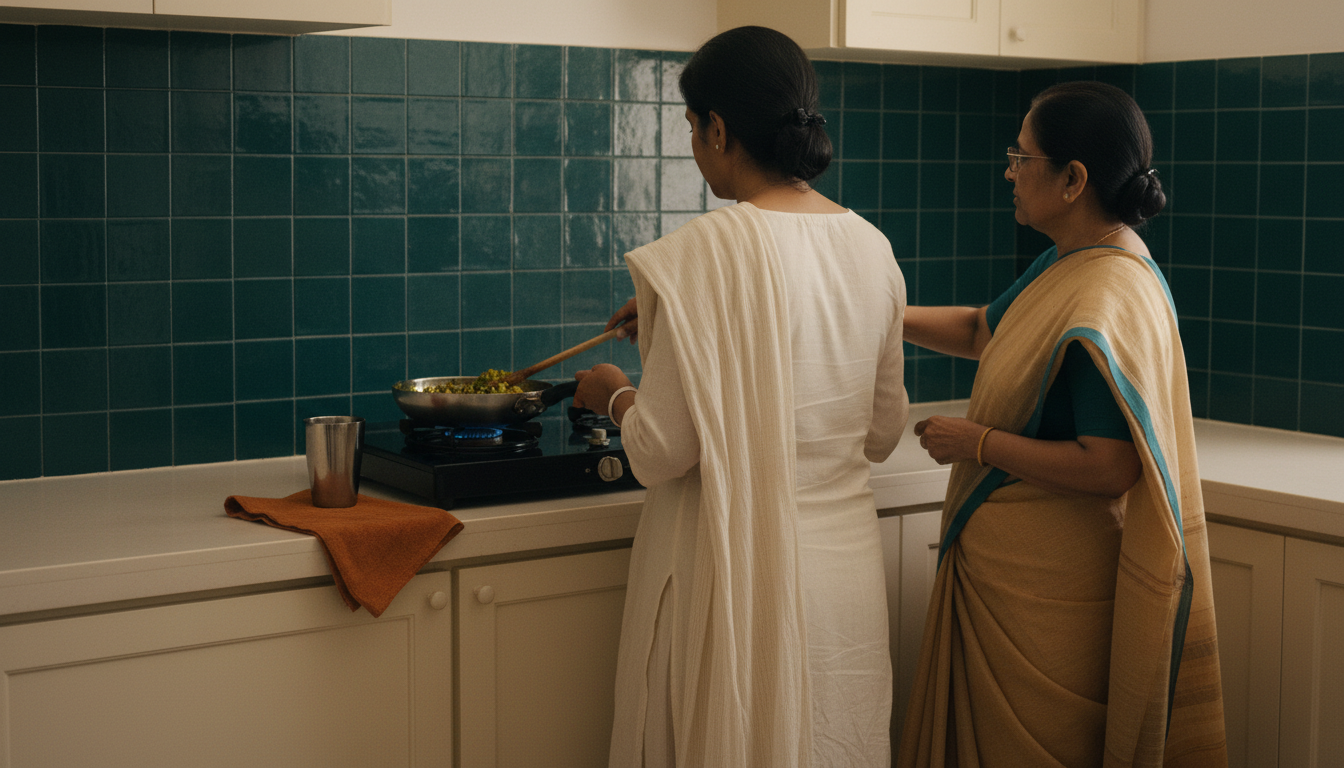
It is Sunday, and you are making the sabzi the way you always make it. His mother stands beside you and says, kindly, "Hamare yahan toh aise hi hota hai." She shows you how the family does it. She is not wrong to say it, and she says it with a smile. You smile back and say, "Ji."
The kitchen goes on. Lunch is good. Nobody says anything else about it.
That night, you find a wet towel on the bed and something sharp comes out of your mouth. "Tumhare ghar mein sab tumhare hisaab se hi hota hai." He looks at you, honestly confused. "Maine kya kiya?" He has no idea where this came from. Neither, for a moment, do you.
One feeling, two addresses
The feeling had a place it belonged: the kitchen, a small remark, a quiet sense of being shown how to do something in your own home. But the kitchen was not a place where you could say it. She is his mother, she was kind, and you love the family you married into. So the feeling went nowhere, and it waited.
Later it found a safer door. The towel was small and the room was private. He was close by. The anger did not choose him because he deserved it. It chose him because he was the person you could be sharp with and still be loved.
Nobody is the villain here. His mother said an ordinary thing in an ordinary way. He left a towel. You held a feeling you did not know where to put. All three can be true on one Sunday.
What the research does and does not say
John Gottman is a psychologist who, with his colleagues, spent years observing couples talk to each other in a laboratory. In that observational work they separated two things that sound alike. A complaint is about one thing that happened: "The towel is on the bed." Criticism is about who the person is: "You never think about anyone."
In the couples they watched, criticism tended to show up more in couples who were struggling. That is a pattern in the couples they studied. It is not proof that criticism causes a relationship to struggle, and it is not a count of every couple.
What it gives you is a useful distinction, offered as something worth trying and not as settled fact. When the anger lands on the wrong person, it can arrive dressed as criticism. "Tumhare ghar mein sab tumhare hisaab se hota hai" is not about a towel. It is not even a complaint about him. It is a sentence about who he is and where he comes from, said about a feeling that began somewhere else.
Why it is so easy to miss
The hard part is that the moment feels like an argument about the towel. You are not planning to be unfair. By the time the sharp sentence is out, it already sounds true to you, because the feeling underneath is real. It is only the address that is wrong.
That is also why asking "why did I say that" in the middle of the fight is hard to answer. The better moment is earlier, when you notice the small sting and have not yet found a door for it.
One thing to try tonight
The same evening, before the anger finds a towel, tell him the one thing that stung. Tell it as news, not as a fight. Pick a quiet minute, maybe when the dishes are done, and say it in a sentence that does not ask him to fix anything:
"Aaj mummy ji ki ek baat mujhe chubhi. Tumse lad nahi rahi, bas bata rahi hoon."
In English: "One thing your mother said stung me today. I am not fighting with you, I am only telling you."
Then stop. Do not add a list of other times. Do not ask him to talk to her. Let him say whatever he says, and wait ten seconds before you answer.
A few things to expect, so they do not surprise you:
- It will probably feel strange to say, because you are naming a sting about someone you love, to someone who loves her too.
- It may sound like a complaint while you say it. It is not one. You are reporting what happened inside you, not arguing a case against him.
- He may be quiet, or may not know what to do with it at first. That is understandable. He is hearing something new, and one sentence does not have to settle it.
You are not asking him to take a side. You are only moving the feeling to the person who can hear it, before it travels the wrong way.
When this is not the right kind of help
If arguments at home leave you afraid, controlled or unsafe, a sentence to try is not the answer. This is relationship education, not therapy or medical advice. If any part of this describes what is happening in your relationship, a qualified professional or a local support service is the right next step, and not an article.
One more step
Each Sunday: one question to ask your partner, the research behind it, and one thing to try. The free Relationship Checkup is open to everyone, any time. Take the Relationship Checkup.
One question a week.
Each Sunday: one question to ask your partner, the research behind it, and one thing to try. The free Relationship Checkup is open to everyone, any time.