
At home he is the bills guy. At the sangeet, everyone gathers around him.
Distance can show you what routine hides. Tonight, tell him one thing you noticed about him, in one line.
- autopilot
- hermes
- attraction
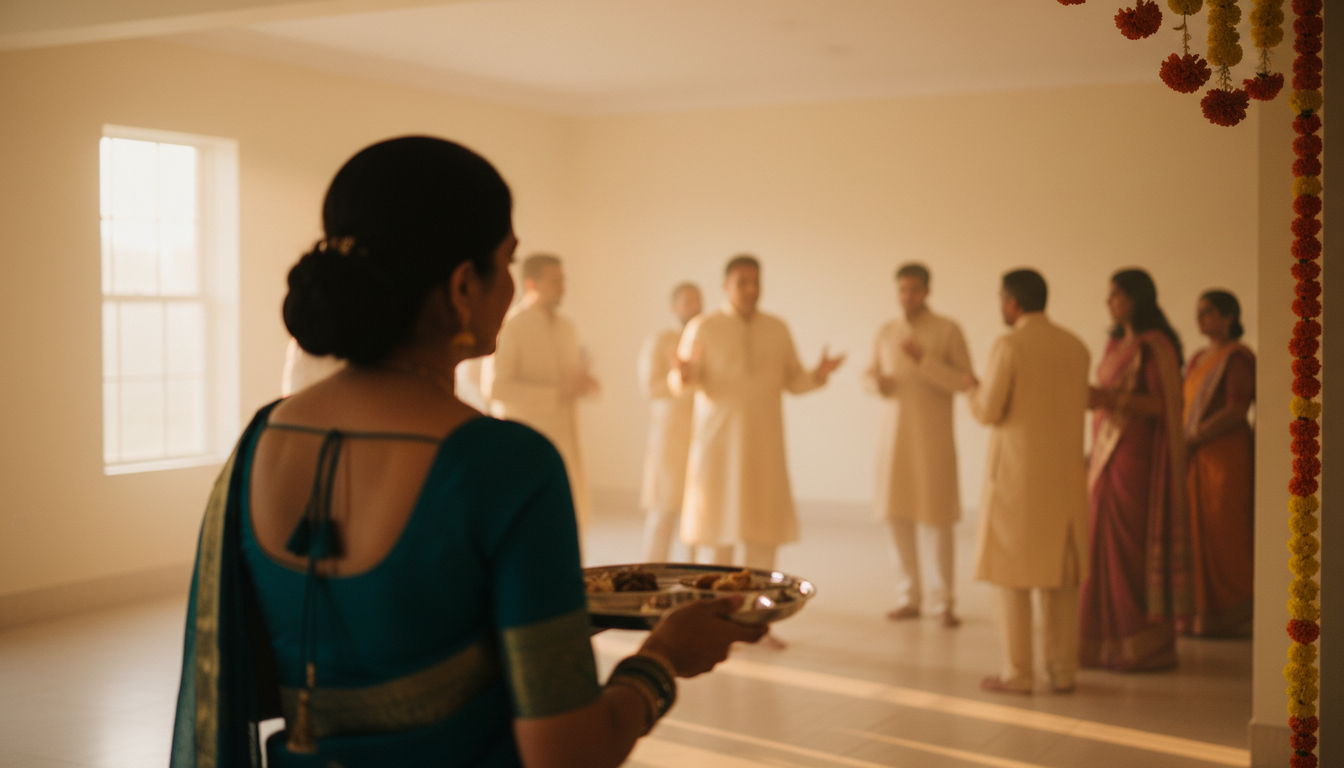
At a cousin's sangeet, you stand near the back of the hall with a plate in your hand. Across the room, he is in the middle of a circle, telling a story. Everyone is laughing. Someone puts a hand on his shoulder.
At home, this same man is the one who asks "gas book kar di?" and reads out the electricity bill. You watch him for a while and a small thought arrives: when did I last look at him like this?
Then he catches your eye across the hall and raises his eyebrows. "Kya dekh rahi ho?"
Why he looks different from a distance
At home, you meet him through jobs. The bill, the gas cylinder, the EMI, what time he will be back. Almost everything you say to each other has a task attached, so that is mostly what you see of him: the person who handles tasks.
At the sangeet, nobody needs anything from him. He is not being asked to do something, and neither are you. You are simply watching someone be funny, warm and easy with other people. You see him the way the room sees him, and that is a side of him your kitchen rarely shows.
The distance matters too. When you are across a hall, you cannot predict the next sentence. You are a viewer, not a participant, and a viewer pays a different kind of attention.
What a couples therapist has said about this
The couples therapist Esther Perel writes about this in her book Mating in Captivity. This is clinical observation from her years of working with couples, not research from a controlled study, so it is a way of seeing and not a proven rule. Her idea is that desire needs some separateness: wanting someone depends partly on not feeling that you know them entirely, or that they are entirely available to you.
Seen that way, the sangeet moment makes sense. For a few minutes he was a little less "known" and a little less "available", because he was somewhere you were not, being someone you do not always see.
The limits of the effect
This is easy to over-read, so here are the limits.
It does not mean you need to spend more time apart. It does not mean the home version of him is the lesser one, because the bills guy is also the man who actually books the gas. It does not mean one good evening at a wedding fixes anything, and it does not tell you how he feels about you.
It also does not mean you should wait for a party. The useful part is not the sangeet. The useful part is that you noticed, and the noticing is something you can do on an ordinary Tuesday.
The experiment: say what you saw
Most of what we notice about our partner stays in our heads. The thought arrives, we feel warm for a minute, and then the dishes need doing.
Tonight, tell him what you saw, in one line. Say it plainly, in your own words. For example:
"Aaj tumhe sangeet mein door se dekha. Achha laga."
Or, if the event was a different one: "I watched you with everyone at the wedding today. I liked it." That is the whole message.
A few things make it easier to run:
- Say it when no task is in the room. Not while you are asking about the milk or the bill. Over chai on the balcony, or while you are both putting the phone down for the night.
- Keep it to one line. If you add a second sentence about how he should be like this at home, it turns from a compliment into a complaint.
- Do not ask for anything back. No "you never say this to me", no question, no comparison.
- Let him reply however he does. He might smile, joke, or say "achha?" and go back to his phone. Any of these is fine for a first try.
What the first try feels like
It may feel strange. Saying something warm and specific to your own husband, with no occasion, can feel oddly formal or even a bit embarrassing, as if you are saying it to a stranger. You might rehearse the line twice and still hesitate. That discomfort is the normal part of trying it, and it is not a sign you are doing it wrong.
He may also be quiet, or surprised, or make a joke to cover his own shyness. One line is not a verdict on either of you. If you want to continue, notice one more thing tomorrow, and keep it just as small.
One question to carry with you
The next time you see him at a distance, in a crowd, at a function, or even across the road, ask yourself: what is the one thing I am noticing right now? Then, when it is quiet, say that one thing.
This is relationship education, not therapy or medical advice. If any part of this describes what is happening in your relationship, a qualified professional or a local support service is the right next step, and not an article.
Each Sunday: one question to ask your partner, the research behind it, and one thing to try. The free Relationship Checkup is open to everyone, any time. Take the Relationship Checkup.
One question a week.
Each Sunday: one question to ask your partner, the research behind it, and one thing to try. The free Relationship Checkup is open to everyone, any time.