
You share a house. Do you know what she is dreading on Thursday?
Living in the same house is not the same as knowing each other's week. Tonight, ask which day she dreads and write the answer down.
- autopilot
- hermes
- connection
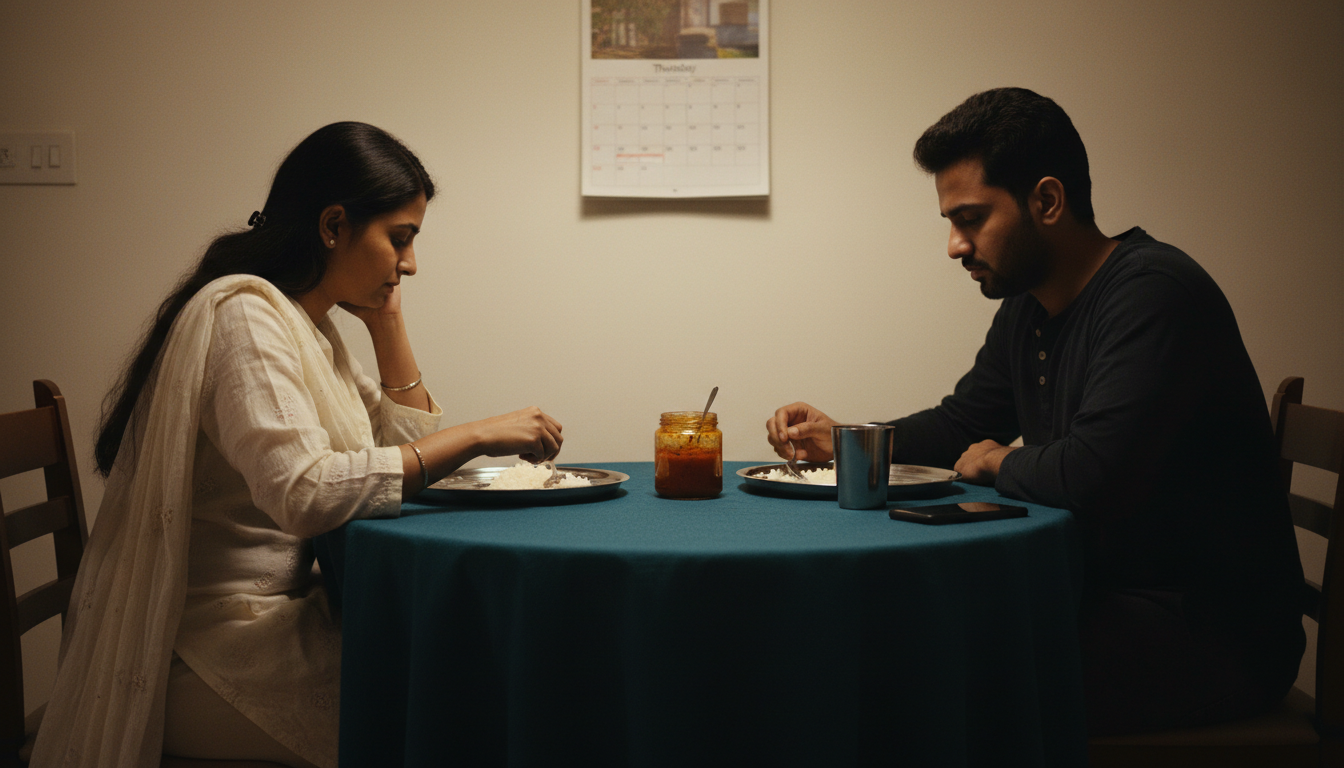
It is Thursday night and dinner is quiet. She is pushing rice around the plate. You ask, "Kya hua?" and she says, "Appraisal tha aaj."
You put your spoon down. You did not know. She says, "Maine bataya tha. Do baar." She did. Once on Sunday, once on Tuesday, and both times you were looking at a screen and said "Haan, haan."
Nobody in that kitchen is a villain. You were tired, she picked a bad moment, and the words went past you. This note is about what that small miss costs, and one question that mends it.
Living together is not the same as knowing
A shared house gives you a shared fridge, a shared bed and a shared Wi-Fi password. It does not give you a map of the other person's week. That map has to be passed across in small pieces: a meeting on Wednesday, a cousin's visit, a call with the bank, a boss who has been short with her.
Most of those pieces are said in passing, while someone is cooking or scrolling. They are easy to miss and they feel too small to repeat. "Maine bataya tha" is the sentence that follows, and it is rarely about the appraisal. It is about whether the telling landed anywhere.
What the research says, and what it does not
Psychologist John Gottman and his colleagues spent years watching married couples in observational studies, recording them as they talked about ordinary things. One of the things they counted was how often one partner turned toward the other when the other made a small reach for attention, such as a remark, a sigh or a question. In those studies, this was among the things that differed between couples who stayed together and couples who did not.
That is a description of ordinary moments in the couples who were watched. It is not a forecast about your marriage, and it cannot tell us why the two groups differed. What it offers is a plausible reason to treat "I have an appraisal on Thursday" as a reach for attention and not as background noise. Take it as an idea worth testing at home, not as a verdict.
Why the screen wins
When a sentence arrives while you are looking at something else, your reply can be automatic. "Haan, haan" costs nothing and ends the moment. But the speaker may hear it as an answer, and later find out it was not one.
There is a second reason it is hard to fix: you cannot ask for the missing information without admitting you missed it. So the week goes on, and the gap grows quietly until a Thursday dinner makes it visible.
One thing to try tonight
Pick a moment when both phones are down. It can be after dinner, on the balcony with chai, or while washing up. Ask:
"Is hafte kis din ka sabse zyada darr hai?"
Then listen to the answer without fixing it. Do not offer advice and do not rush to reassure. Ask one follow-up if you want, such as "Kyun us din?" Then open the calendar on your phone and write her answer on that day, in front of her. Write the person's dread, not just the event: "Thursday, appraisal, nervous."
You can also do this the other way round. If you are the one whose week is full and unseen, answer the question honestly and let your partner write it down.
Here is what to expect from the first try. It may feel like an interview, a little stiff and a little staged. You may notice an urge to fill the pause or to reassure. That awkwardness is part of the move, and it eases with repetition. The aim is not a deep conversation. It is only that one real day of her week now sits in your calendar, where you can see it that morning.
Afterwards, notice two things. What did you learn that you did not know? And on that day, did you find yourself thinking of it before she mentioned it?
When this is not the right kind of help
If you do not feel safe telling your partner about your week, or if what you tell them is used against you, a question at dinner is not the answer. This is relationship education, not therapy or medical advice. If any part of this describes what is happening in your relationship, a qualified professional or a local support service is the right next step, and not an article.
A question to carry into the week
Each Sunday: one question to ask your partner, the research behind it, and one thing to try. The free Relationship Checkup is open to everyone, any time. Take the Relationship Checkup
One question a week.
Each Sunday: one question to ask your partner, the research behind it, and one thing to try. The free Relationship Checkup is open to everyone, any time.