
His mother calls at dinner, and you go quiet
When his mother's nightly call lands at dinner and you go quiet, the sulk says what you did not. Ask for half an hour of the meal, and do not ask him to choose.
- autopilot
- hermes
- communication
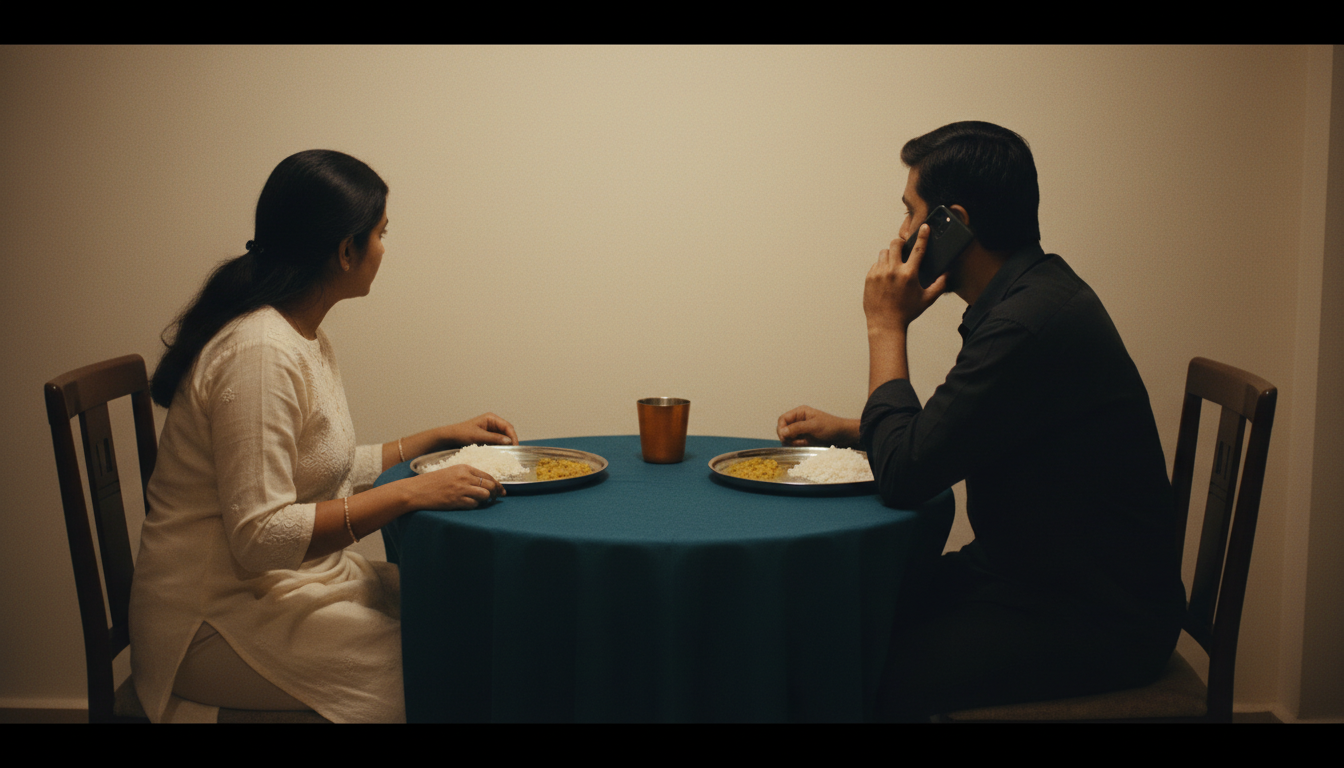
It is nine at night. The plates are laid, the dal is hot, and his phone lights up with Mummy. He picks it up, smiles, and says hello in the voice he uses only for her. You sit down. You wait.
Twenty-five minutes later the dal is cold. You have said nothing. When he finally hangs up, you put the dishes down a little harder than you need to. He looks at you, honestly puzzled, and says, "Mummy was asking whether you had eaten."
That question is kind. His mother is not the problem in this scene, and neither is he. And you are not wrong to feel something, either. Two things are tangled together here, and the quiet at the table comes from not having pulled them apart.
What is actually bothering you
It is rarely the call. A mother phoning her son every night is an ordinary, loving thing, and you may even like that he is the kind of son who picks up. What stings is what the call costs: a meal you both sit down for, spent with one of you on the phone and the other watching the food go cold.
So there are two separate questions. One is "Should he talk to his mother?" and the answer is yes, of course. The other is "Can the first half hour of dinner be ours?" That one has not been asked out loud. Instead it comes out as banging steel plates, and he may read the noise as anger at his mother, which it is not.
What a study found, and what it cannot say
Researchers James Roberts and Meredith David, then at Baylor University, published a survey in 2016 of adults in romantic relationships. People who described more of their time together being interrupted by their partner's phone also described lower satisfaction with the relationship. That is an association between two things people reported. The survey cannot say which came first: phone interruptions may wear on a relationship, or a strained relationship may make the interruptions sting more, or both may be true at once.
It is also a study of phones in general, not of mothers. Nothing in it says a nightly call from a parent harms a marriage. What it gives you is a reason to take your own small feeling seriously: a meal repeatedly broken by a phone is a pattern worth naming, whoever is on the other end.
Why you go quiet
Going quiet feels safer than asking. If you say "Can she call later?", you fear it will sound like you are asking him to pick between you and his mother. So you say nothing, and the nothing gets loud. He cannot answer a request you never made, and you cannot be comforted for a hurt he does not know about.
One thing to try tonight
Before the call comes, before the plates are even down, say this once, in a normal voice:
"Mummy se baat zaroor karo. Bas khaane ka aadha ghanta hum dono ka rakh lein?"
In English: talk to your mother, of course. Can we keep just the first half hour of dinner for the two of us?
Notice what the sentence does. It begins with a yes to his mother, so he does not have to defend her. It asks for a small, fixed slice of time, half an hour, not the whole evening. And it never asks him to choose. If the call comes at 9:05 anyway, he can say, "Mummy, I will call you back after dinner," or he can decide that tonight the call matters more. Both are his to decide. Your part is only to have asked.
The first time, saying it will feel awkward, and you may feel a little silly asking for something that seems so small. It may also not go smoothly: he might forget, or the call might come early. Try it for a week before you decide what it means, and say the same sentence each time rather than adding a longer explanation.
A note on what this is
This is relationship education, not therapy or medical advice. If any part of this describes what is happening in your relationship, a qualified professional or a local support service is the right next step, and not an article.
Where to go next
Each Sunday: one question to ask your partner, the research behind it, and one thing to try. The free Relationship Checkup is open to everyone, any time: take the Relationship Checkup.
One question a week.
Each Sunday: one question to ask your partner, the research behind it, and one thing to try. The free Relationship Checkup is open to everyone, any time.