
His parents are asleep next door, so you fight in whispers
A fight in whispers has no room to finish, so it moves to the breakfast table. Say one sentence that parks it, with a time and a place to finish it.
- autopilot
- hermes
- conflict-repair
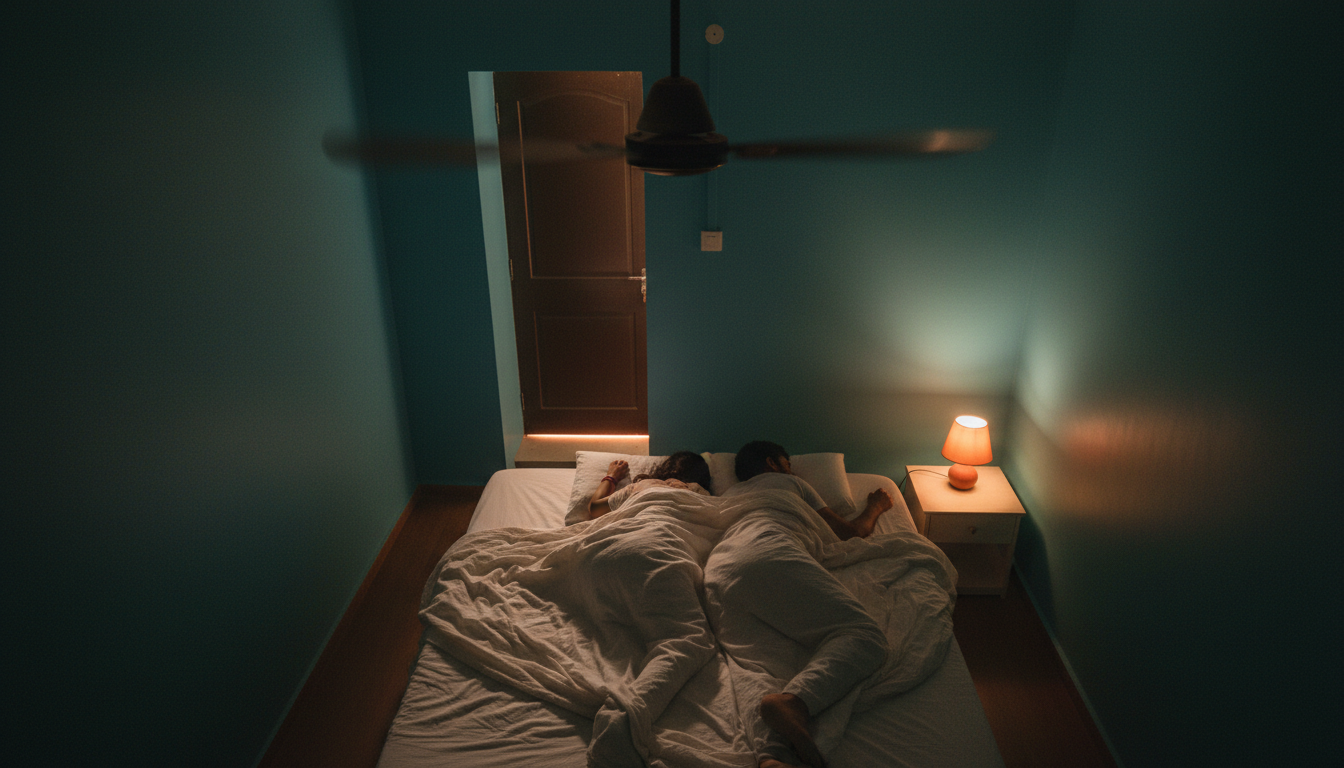
It is 11:30 at night. His parents are staying with you for two weeks, and they are asleep in the next room. The fan is on high, and you are both lying very still, speaking at the volume of someone reading a secret.
It started with something small: who takes leave on Friday. Now it has a sharp edge, and every sentence has to be squeezed down to a hiss. He says, "Dheere bolo, mummy jaag jayengi." You say, "Chhodo, so jao." You turn over. Nothing was decided.
In the morning you smile at his parents over the chai. You pass the sugar. The fight is still lying between the two of you, and nobody has said a word about it.
What the whisper does to the fight
A fight needs a little room. It needs a voice that can go up and come back down, a pause that can be long, and a chance to say the sentence twice because the first time came out wrong. A whispered fight has none of that. Every sentence has to be short and tight, so what comes out is the sharpest version of what you meant.
And it cannot finish. Neither of you can say "okay, I hear you" in a way that settles anything, because the whole exchange is held down by the walls. So one of you ends it with "chhodo, so jao". That is not peace. It is a fight with the lid put back on.
His parents are not the problem here. You love them, and you are glad they are staying. The house is simply full, and a disagreement has nowhere to go. So it goes to the breakfast table, and then into the next day.
Notice, too, that you are both doing something kind. You are protecting two people you care about from hearing you argue. The trouble is only that the kindness leaves the argument unfinished.
A pause that has an end
The researcher John Gottman ran lab studies in which couples were stopped in the middle of an argument and asked to read magazines for about half an hour before starting again. When they returned to the conversation, their heart rates were lower than when they had stopped. This was one researcher's lab work with American couples, so it tells you about a pause in that setting. It does not tell you what happens in your bedroom, or in your house, with your parents next door.
But it points to something worth trying. The pause in that lab had an end: the couple knew they were coming back. A pause that comes with a promise to return is different from a fight that is dropped. It may be that the first lets both people settle, while the second leaves both people still carrying it. That is a way of looking at it, not something proven about your home.
That is the difference between "chhodo, so jao" and a parked fight. One is a door shut with nothing behind it. The other is a door closed with a note stuck on it, giving the time to open it again.
One thing to try tonight
The next time the whispering starts, stop before the sharp lines come. Say this, in a low voice:
"Yeh baat yahan poori nahi hogi. Kal subah walk par karte hain. Pakka."
That is the whole move. It names that the talk cannot finish here, and it gives a time and a place: tomorrow morning, on a walk. A walk gets you out of the house, so you can talk at your normal voice, side by side, with no walls listening.
Then actually stop. Do not add one more point, even a small one. Turn over, and let the fan do its work.
A few things to expect from the first try:
- Stopping mid-sentence will feel unfinished. The point you were about to make will keep coming back to you in the dark.
- It may feel like you have lost, especially if you were the one with the better argument. Parking the fight is not giving in. The argument is still there in the morning.
- The next day, one of you may want to skip the walk. Go anyway, even if you only walk to the corner and back, because the promise is what makes the pause different from a dropped fight.
If the walk goes badly the first time, try it once more before you decide anything about it.
On the walk
Start small. Say what the fight was about in one sentence each, without correcting the other person's version. Then decide the thing you were really deciding: who takes leave on Friday. You may find it is smaller now, and you may find it is the same size. Either way, you are having it at a volume where both of you can be heard.
What to notice afterwards
Watch how the breakfast table feels the next morning. Notice whether you are still smiling at his parents with something held behind it, or whether the smile is just a smile. That difference is worth paying attention to. It tells you whether the fight was parked or only buried.
This is relationship education, not therapy or medical advice. If any part of this describes what is happening in your relationship, a qualified professional or a local support service is the right next step, and not an article.
Each Sunday: one question to ask your partner, the research behind it, and one thing to try. The free Relationship Checkup is open to everyone, any time. Take the Relationship Checkup
One question a week.
Each Sunday: one question to ask your partner, the research behind it, and one thing to try. The free Relationship Checkup is open to everyone, any time.