
Every Sunday has a plan. What if one had none?
A Sunday with no plan can feel like laziness to one partner and like closeness to the other. This Sunday, try one hour at home, no plan, phones in another room.
- autopilot
- hermes
- connection
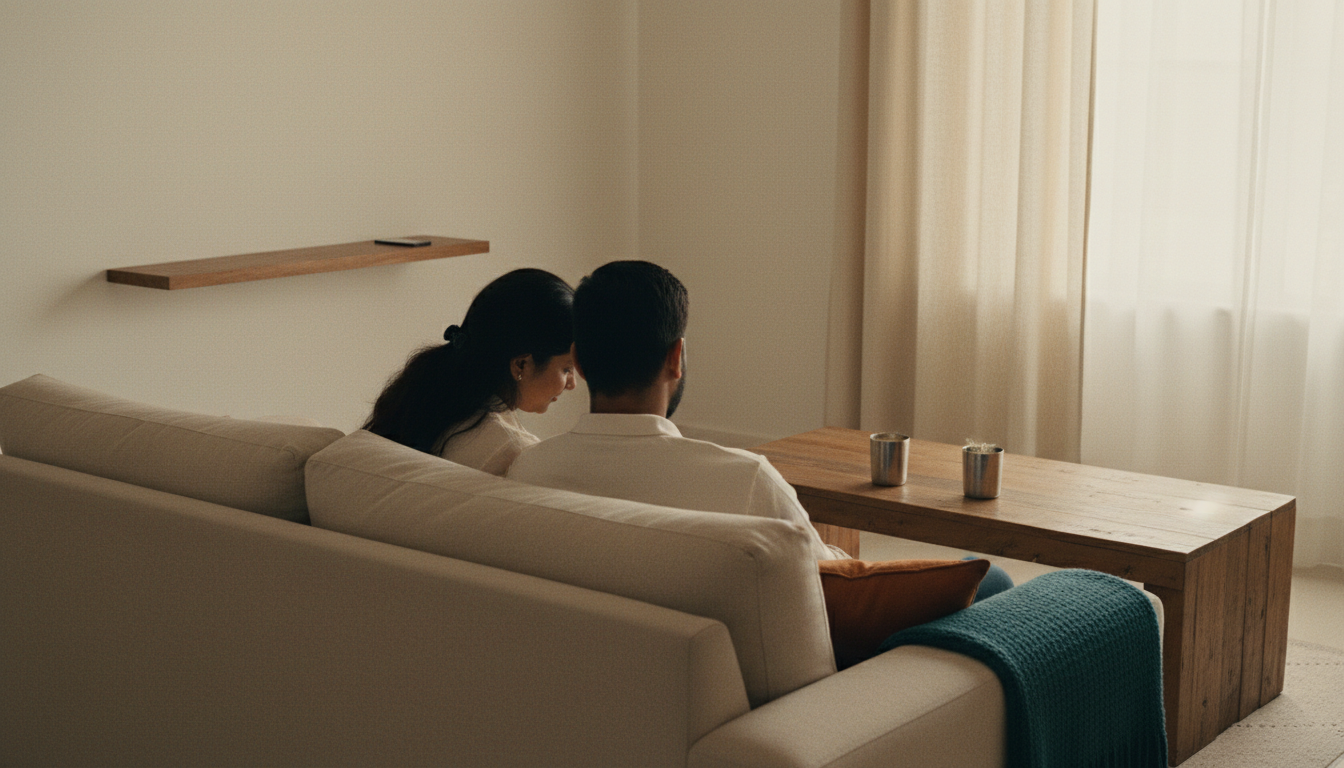
On Saturday night he reads out Sunday like a timetable. The mall at eleven. His cousin's house at four. The car service somewhere in between, if there is time.
She listens, then asks, "Ek Sunday bas ghar par nahi reh sakte?"
He hears a complaint. Sunday is the one day there is time to get things done, and she wants to do nothing. She does not mean the day should be empty. She means the two of them, on the same sofa, with nowhere to be.
Nobody in this scene is wrong. He is trying to look after the family, the car and the relatives. She is asking for something that has no line on the list. This note is about what a plain afternoon at home might give a couple, and one hour to try this weekend.
Why a plan feels safer than a sofa
A plan gives a day a shape. You know what you are doing, who you are doing it with and when it ends. A free afternoon has none of that, and the first few minutes can feel like something is missing.
There is also a quiet worry underneath. If we sit here with nothing to do, what will we say? A mall trip or a visit to relatives carries the conversation for you. A sofa does not.
So it is easy to hear "let us stay home" as "let us be lazy". More often it may be closer to "let us be together without a reason".
What the research says, and what it does not
Barbara Fiese and her colleagues at Syracuse University reviewed fifty years of studies of family routines and rituals. In that review, families who kept strong, meaningful rituals also reported closer relationships.
That is an association, and it needs care. Most of the studies were correlational, so the review cannot tell us that rituals create closeness. Close families may simply keep more rituals. It also looked at families, not at one couple on one sofa.
What it does give us is a reasonable thing to test at home. A shared habit, kept on purpose, may be worth more than another errand done together.
What an unplanned afternoon can be
It does not have to be a big ritual. It can be a small, repeatable thing: the same sofa, chai, a cricket match on low, a half-finished crossword.
The point is not what you do. It is that both of you chose to be in the same place without anything else asking for you. Whatever comes up in that hour, a story, a silence, a plan for next month, comes up because there is room for it.
One thing to try this Sunday
Pick one hour on Sunday afternoon. Dopahar works well, after lunch and before the evening begins. Put nothing in it. No mall, no call to a relative, no errand squeezed in.
On Saturday night, say it plainly to each other:
"Is Sunday kahin nahi jaana. Bas hum aur sofa."
Then, when the hour starts, put both phones in another room. Sit on the same sofa. You can talk, read, watch something or say nothing at all. If one of you wants to get up and do a chore, notice that, and sit for a little longer.
Here is what to expect from the first try. Around the twenty-minute mark, one or both of you may feel that you should be doing something. That feeling is part of the discomfort, and it does not mean the hour is failing. Do nothing anyway.
If you are the one who made the Sunday plans, this may feel like giving something up. It is one hour, and the plans will still be there at five.
Afterwards, notice two things. What did the two of you talk about when nothing was asked of you? And who was the first to reach for a phone, or a chore?
When this is not the right kind of help
If a free afternoon at home feels unsafe, or if staying in is met with anger, control or fear, a quiet Sunday is not the answer. This is relationship education, not therapy or medical advice. If any part of this describes what is happening in your relationship, a qualified professional or a local support service is the right next step, and not an article.
A question to carry into the week
Each Sunday: one question to ask your partner, the research behind it, and one thing to try. The free Relationship Checkup is open to everyone, any time. Take the Relationship Checkup
One question a week.
Each Sunday: one question to ask your partner, the research behind it, and one thing to try. The free Relationship Checkup is open to everyone, any time.