
The hug in the kitchen that asks for nothing
When every hug is the first step towards something else, it starts to feel like a question. Tonight, one twenty-second hug that asks for nothing.
- autopilot
- hermes
- intimacy
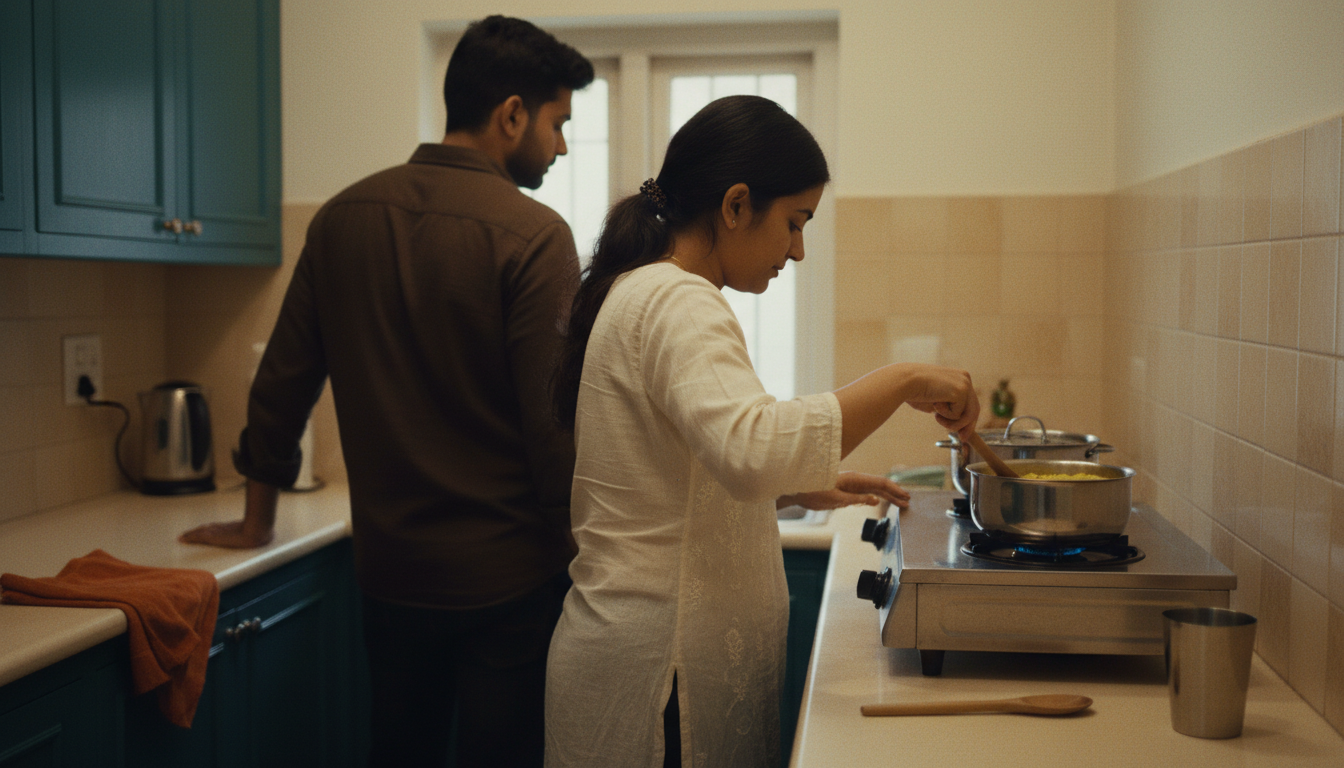
She is at the stove, stirring the dal. You come up behind her and put your arms around her. Her shoulders go still. She does not pull away. She just waits, the way you wait for a lift to arrive.
You feel it, and it stings. You meant it as a hug. But somewhere in the last few months, a hug from you stopped being only a hug.
When a hug becomes a question
Nobody decides this. It builds up slowly. A hug in the kitchen is followed, a few times, by a hand that moves, or a look, or a "so, tonight?" Nobody did anything wrong on any one evening. But the body keeps count. After enough of these, the hug can be read as the first step of a request, and she answers the request before it is asked: she braces.
That bracing can be quiet. She may not say "abhi nahi" at all. She may just go still, or turn back to the stove a little too quickly.
The cost may run in both directions. For her, an ordinary touch no longer feels free, because it might need an answer. For you, each stiffening can read as rejection, so you reach less often, or you reach with more hope, which makes the next hug heavier. Neither of you chose this. Two people who love each other can end up in a house where touch has become a small negotiation.
This is a guess about one possible shape, not a diagnosis of your home, and only the two of you know what is true in yours.
What one study found about hugs
Michael Murphy, Denise Janicki-Deverts and Sheldon Cohen are psychology researchers who interviewed 404 adults every evening for two weeks. In this diary study, on days that involved a conflict, people who had received a hug that day reported a smaller rise in negative mood than people who had not.
The limits matter. This is correlational: it shows two things appearing together on the same days. It does not show that a hug caused the better mood, and it says nothing about what any one hug means in your kitchen. What it gives you is a reason to take plain, ordinary hugs seriously, as something worth protecting rather than something to spend.
The move: a hug that asks for nothing
The idea is simple. Make one hug that cannot be a question, because it leads nowhere and wants nothing. And you are the one who ends it.
That last part is the whole move. A hug that asks for nothing only becomes believable when the person hugging lets go first, on their own, before anything else can begin.
One thing to try tonight
Pick a moment that has no plan attached to it: she is at the stove, or folding clothes, or putting on her chappals at the door. It should not be when the kids have just gone to sleep, and it should not be at bedtime. Those are the times the hug usually means something else to her.
Put your arms around her and count twenty seconds in your head. Do not move your hands. Do not say anything. Breathe out slowly.
At twenty, let go yourself and say: "Bas itna hi." That is all. Then go back to whatever you were doing, and leave the evening exactly as it was.
If she goes still at first, do not take that as the answer. Her body has learned something over months, and one hug will not undo it. Stay for the twenty seconds anyway, and notice what happens in the last ten.
If you are the one who braces, you can try the other side of this. You do not need to say anything. You can simply let your shoulders drop a little and notice that, tonight, nothing is being asked.
What the first try feels like
It may feel odd. Twenty seconds is longer than it sounds, and you may notice your own wish for the hug to turn into something. You may feel a bit foolish saying "bas itna hi" and walking away. She may be unsure what is going on, and she may ask. You can tell her the truth: "I just wanted to hug you. That is all."
Letting go yourself is the hard part. It is also the part that does the work, because it is the proof that the hug was not a question.
You may need to try this on more than one evening before it feels easy. A habit built over months does not change in a night.
A note on what this is not
This is relationship education, not therapy or medical advice. If any part of this describes what is happening in your relationship, a qualified professional or a local support service is the right next step, and not an article.
If your partner flinches because she is afraid of you, or if touch has been pushed on her when she said no, that is not a matter of better hugs. It calls for support from a counsellor or a local service, not for an exercise.
Where to go next
Each Sunday: one question to ask your partner, the research behind it, and one thing to try. The free Relationship Checkup is open to everyone, any time. Take the Relationship Checkup.
One question a week.
Each Sunday: one question to ask your partner, the research behind it, and one thing to try. The free Relationship Checkup is open to everyone, any time.