
Awake at three in the morning
You are not awake at three because something is wrong. You are awake because the day is still running. One slow word, on the out-breath, in the dark.
- sleep
- sikh
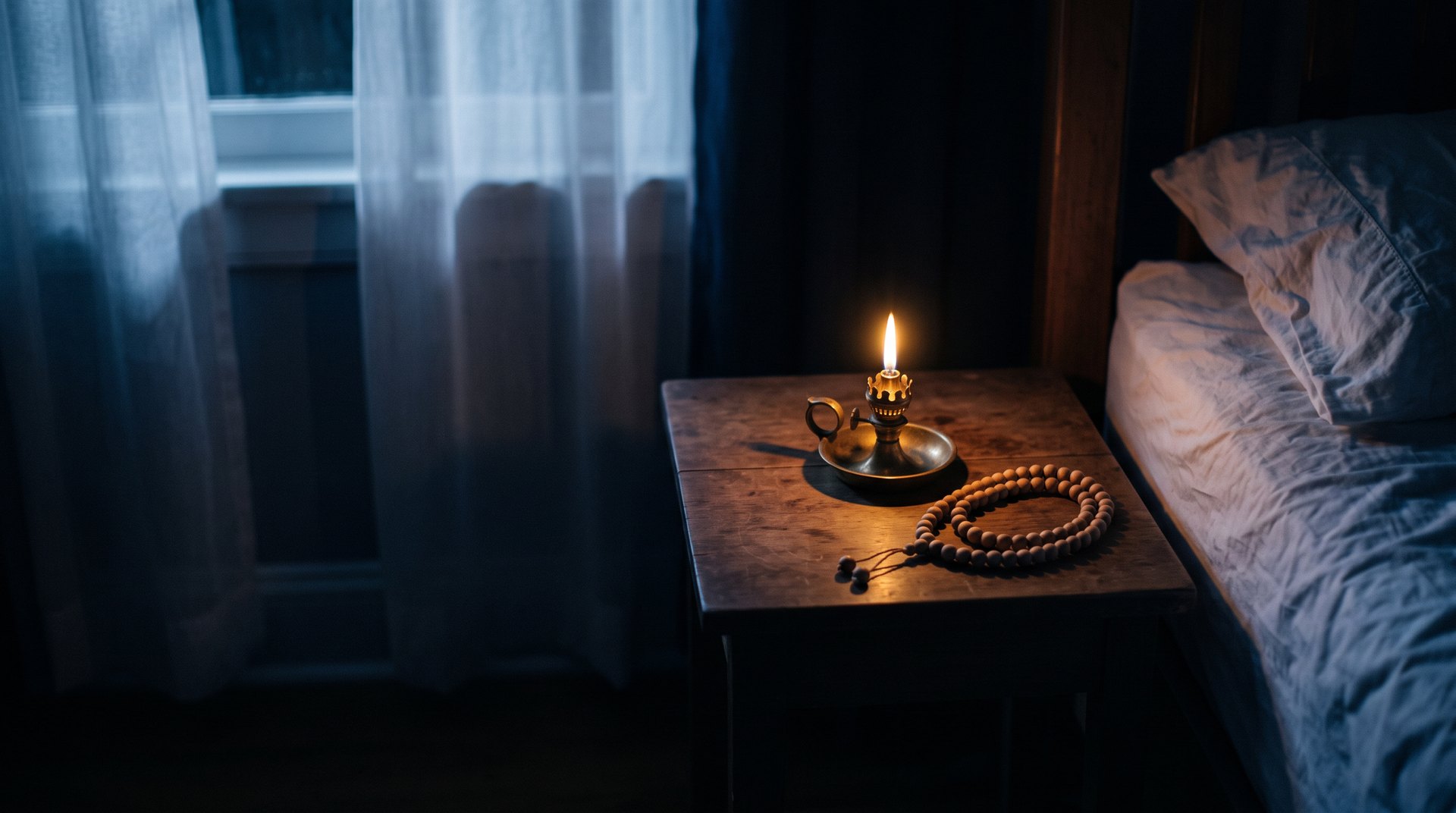
You wake and the room is dark and you already know what time it is without looking. The body is tired but something behind the eyes is wide open. A conversation from yesterday starts again from the beginning. A list forms. You turn over, and the turning is a decision, and the decision keeps you awake. You are not awake at three in the morning because something is wrong with you. You are awake because the day is still running, and nobody told it to stop.
If you searched for insomnia, can't sleep, waking at night, sleep anxiety, a racing mind at night, 3am waking or trouble falling asleep and landed here: this is a practice, not a treatment. It sits well beside help from a doctor or therapist; it does not replace it. What it does is give the mind one slow word to hold on the out-breath, so the breath can lengthen and the thinking can lose its grip for a while.
The practice
The chant is Waheguru simran. The word is Waheguru, said Waa-hay · Gu-roo. It means wonder at the one who brings light into darkness. You do not need to believe anything about it. You need only say it.
Lie down. This is one of the few practices where lying down is allowed, and for this one it is the right posture. Turn the lights off. No screen in the room, or the screen face down and silent.
Breathe in through the nose and say nothing. Breathe out and say Waheguru, slowly, under your breath or in your mind, letting Wa-he open and gu-ru settle as the breath runs out. Then breathe in again and say nothing. The inhale is left empty. Only the exhale carries the word.
Do this for 108 breaths, or until sleep takes you first. At a slow pace this is about eleven minutes. Do not count strictly. If you lose the count, you have not lost anything; begin again from wherever you are. The point is not to finish. The point is to be doing one slow thing when sleep arrives.
The time of day is the last eleven minutes before sleep, in the dark, every night for a while.
If you wake in the night, do not check the time. Knowing the hour only gives the mind a number to work with. Stay where you are, keep your eyes closed, and say the word on the exhale in the dark. Let the inhale stay empty. Keep going until you are asleep or until it is light.
If you want to count, a mala of 108 beads does it for you: move one bead with each repetition, and when your thumb reaches the larger bead, stop, or turn the mala round and go back the way you came.
What it is actually doing
A breath with a longer exhale tends to settle the body's arousal. Saying a word on the way out, slowly, makes the exhale longer without you having to manage it. That is most of what is happening here.
The rest is attention. A mind that is awake at night is usually running the same few thoughts on repeat, and each one asks for a response. One word, said the same way each breath, gives that attention a single low-demand place to rest. Many people find the thoughts do not stop so much as lose their audience.
None of this is instant. The first night it may feel like a chore. Over a week or two the word starts to arrive on its own when you lie down, and that is when it begins to do its work.
Around the practice
A fixed wake time. Get up at the same time every morning, even after a bad night. It is tempting to sleep in to repay the debt. Most people find the debt is better paid by being properly tired the next night.
Morning daylight. Within an hour of waking, get outside, or stand at an open window, for a few minutes. Daylight in the morning is the clearest signal the body has about when night is.
A screen-free half hour. The last half hour before bed with no phone, no laptop, no television. Read something on paper, wash up, sit with a cup of something warm. The practice above is the last part of that half hour.
Questions people ask
Does chanting help with insomnia? Many people find it helps them fall asleep, and helps them return to sleep after waking. It is not a treatment for insomnia, and if you have been sleeping badly for a long time, a doctor is the right person to talk to. What the practice does is lengthen the exhale and give the mind one thing to hold.
Why do I keep waking up at 3am? There are many reasons, and some of them are medical, which is why this page is not a diagnosis. What the practice offers is something to do when it happens that is not lying there thinking. Say the word on the exhale, do not check the time, and let the night be the night.
Can I do this lying in bed, or do I have to sit up? Lying in bed is the intended posture for this one. It is a practice, not a treatment, so there is no wrong way to hold it; the only rule is that the word goes on the exhale and the inhale stays empty. If you fall asleep in the middle, that is the practice working.
Where to go next
The practice above is complete on its own. When another moment comes, the Journal has a practice for it, and a new one arrives each morning. A short version of each goes out on Instagram, and the long meditations are on YouTube.
One chant a week.
Each Sunday: one chant for the week ahead, how to say it, and when. One click stops it, and the list is never sold or shared.